Sometimes it boggles my mind how much is available on YouTube. I've taken full advantage by posting all kinds of clips on this blog (er, but watch them before the copyreich people get them taken down.)
Up until now, I've sort of limited myself to posting one clip per entry (I think the most I ever did at once was three.) But for something different, I thought I'd do a list that's naturally suited to one of the most popular categories on YouTube – music videos (especially since MuchMusic and MTV apparently no longer play them.)
This isn't a “These are the absolute best music videos I've ever seen” as that would be impossible to compile. Instead, it's more of an impressionistic stream of consciousness list of some of the videos I like for all kinds of reasons – great direction, great match of music and lyrics, innovative ideas.
No real criteria used otherwise except that I was trying not to pick the obvious ones. Oh, and apparently I really like videos that play with time in some way or do something unique instead of just having the singer lipsynching – have celebrities and regular folk lip synching instead, show people listening and reacting to the song on headphones or just show a stereo speaker playing the song.
Since Pace was born, I've sort of had my ear tuned to what other friends and acquaintances have been naming their babies. I grew up with one of the most common boy's names of the 1970's and although I didn't hate it, there's definitely something out-of-whack when you're in a graduating class of 44, half of those are presumably male and of those 22, fully 3 (or 15%) have the same first name.
I admit that probably played at least a small role in the name we chose for Pace. As I've mentioned, picking a boy's name was infinitely harder for us than picking a girl's name – in fact, we had two completely acceptable options for a girl, long before we even planned to get pregnant!
As I explained to someone who complimented the name on Facebook, what we were going for with Pace was a couple things – we wanted something unique (and not just “add an x” to change “Jackson” to “Jaxon” unique) but that wouldn't require Pace to spell out his name for people for the rest of his life (again, see “Jaxon” alternate spelling for an example.) Of course, we're beginning to realise that Pace doesn't always fit this criteria and we'll still get “Pace? How do you spell that?” but I guess that's what we get for picking a fairly uncommon name, no matter what it was.
Anyhow, to get back to my initial point, here are the names of some babies we know who were born within the last year or three. Definitely not a Jason or Jennifer among them and it looks like we're not the only ones going for that unique yet simple name for our child (I blame Chris Martin and Gwenyth Paltrow)…
Alise Amara Anese Anise Brooklyn Cooper Cora Dennon Eamon Emmerson Emersyn Garrett Grace Gracie Hali Hayden Hudson Ian Jeren Kiran Krisily Kyan Lennox Liam Maxwell Mandred Nadia Noah Olivia Reginald Ryce (I thought it would be pronounced “Reece” but it's “Rice”. And you thought “Pace” was daring! ) Saron Sawyer Sierra Sophia Tyson Wyatt Zia
When I was in Calgary, I went in a hockey pool with my cousin and his buddies every year. The rules we used were fairly standard in that the team you picked at the draft was the team you were stuck with for the year (in retrospect, dropping your lowest scoring player – ie. the guy who got injured in week three – would've been a nice rule to have. But I'm not bitter about drafting Paul Kariya in 2003.)
But beyond that, this pool had an interesting wrinkle I really liked – instead of everybody paying a set entry fee ($20 or whatever) and drafting who they felt was the best available at the time, you paid $1 per million of salary. So if you drafted a team like you owed the Rangers or Red Wings of the early 2000's, you were going to put $70 into the pot. If you worked the draft like a small market Canadian team, you're on the hook for $35 maybe with the chance for a really big payoff. Instead of drafting someone like Peter Forsberg or Jaromir Jagr in the early rounds, you'd see guys trying to pick sleepers who were on low money contracts and poised to break out for big points (My proudest moment was picking sleeper Jarome Iginla in 01-02 for a buck seventy when he had his big breakout season, scoring 52 goals and 44 assists and jumped to a $5.50 player the next year.)
Another great memory was when one regular couldn't make the draft when we did it at our place so Shea was enlisted to draft for him. Using a unique strategy of “picking the most expensive guy available” and/or “picking the guy with the funniest name – ie. Satan, Palffy, etc.”, she ended up winning the guy some cash when he finished in second place!
So anyhow, that's all a long intro to say that I haven't done a hockey pool in a couple years but was glad to see that Facebook has one. They're using the “pick one player from a group of six similar players” style of draft which is pretty fun too. Categories include “Elite”, “Sizzle”, “Fizzle?”, “European”, “Goon”, “Goalie”, etc. Plus they're allowing four trades throughout the year in case you pick a bum. (Oh, and they also let you name your team – I'm “Head Tale” – so if you're playing too, feel free to post your team name as a comment so I know whose butt I'm kicking! )
Here are my picks and justifications Elite – Sidney Crosby Seemed like a no-brainer. So far, Crosby = 1 points. Heatley = 7. Yep, I have no brain.
Sizzle! – Jarome Iginla Always a soft spot for “Iggy” but also a considered pick since Iggy was third in points per game average last year and only a big injury kept him from ending up in the top three for league scoring. Off to his typical slow start but he always seems to pick it up as the year goes on so I remain hopeful and am unlikely to trade him.
Fizzle? – Mats Sundin I hate the Leafs like any good Canadian outside the greater metropolitan Toronto area should. But I've always liked Mats Sundin and he's serving me well so far by leading this group.
Expecting Big Things – Marc Savard Probably my stinkiest pick in the draft. Made the classic draft mistake of chasing somebody who did something good the year before (Savard put up great numbers of a fairly crappy team) instead of going for somebody with potential for this year – ie. Paul Statsny who is kicking ass so far.
European Flair I picked the wrong Red Wing – Datsyuk has 2 points, Zetterberg has 8.
Veteran Leaders Saku Koivu and like a lot of picks, my bias towards Canadian teams is showing (but unfortunately, I didn't pick any of the Ottawa's big three who are totally dominating so far.)
Warhorses Nik Lidstrom is dominating this group so far. Yay me!
Future Norris Dion Phanuef. Beyond my Flames fandom, this guy almost beat a 20 year old record for goals by a rookie defenceman when he scored 20 in 2005-06 . Considering how wide open the NHL was in 1998 when Brian Leetch set the record (23), that's pretty impressiv
e!
Goalies Miikka Kiprusoff and see the last entry for very similar reasoning – Flames fandom + record setting performances.
Goons Shane O'Brien. Is there even fighting in the “new” NHL? This one was a toss-up and also has my least favourite aspect of this pool by far – every PIM gets you a point (the draft we did in Calgary only gave you one quarter of a point as a quality goon should be able to get 400 PIM and a top scoring player will get around 100 points.) The way it's set-up right now, your whole pool result will be completely dominated by the goon you pick.
I had a meeting in Regina this morning so took the rest of the afternoon off to do various “only doable during a weekday” errands in the city. One of the things we did which isn't necessarily a weekday-only activity was to stop at the Cornwall Centre which is Regina's downtown shopping mall.
During the course of our shopping, we had occasion to use their family change room which is, I am pleasantly surprised to say, nicer than some hotel rooms I've stayed in in my life. (Seriously!)
You gain access via a security buzzer so the great Mall Security Gods know that you're a legit user of this service. Once the door opens, there's a main room that has a change table, a sink, and two leather chairs. Beyond that through another door, there's an ante-room that has another sink, a toilet and what, on first glance appeared to be a bidet (“how continental!”) but upon closer inspection (but not too close) turns out to be a miniature toilet for kids! How fricking cool is that?
Loyal reader Jill B. trained her wee bairn to do his business within like two weeks of being born but Pace isn't quite that advanced. Still, I'm pretty sure that the Cornwall is going to be a destination of choice when he is potty-trained, simply to use that cute little toilet. Who knew that investing in toilet facilities would have such a positive impact on the mall's bottom line? (er, no pun intended.)
Actually, that's a pet theory of mine – I think any business can improve its bottom line by having very clean, accommodating facilities. Gas stations tend to be society's default “away from home” rest rooms but to bring this around to libraries, I think we, as libraries, also have a role (again, no pun intended – god, it's hard to be serious about this topic. But I really am!) in providing these types of amenities to those who want to use them. In fact, I think it's a natural extension of our position as a public institution where information flows freely for all (okay, I give up!)
I was HUGELY disappointed to go into the new Montreal central (?) public library last year which, if I remember correctly, had recently undergone a grand redesign – except it appears that they completely forgot to redo the bathrooms as part of this upgrade. Each floor had very small, hard-to-find facilities with walls painted institutional (aka “puke”) green and none of the features of today's modern bathrooms – touchless faucets, paper and soap dispensers, bright lighting, unique colours and designs throughout. I mean, I'm not saying libraries should suddenly dedicate 95% of their budgets to the cans. But they shouldn't dedicate 0% either.
The link to “Great Tits” a couple days ago was something I saw on Reddit and found quite funny. But, inspired by this entry, here's one I came up with myself that's actually pretty informative.
Before stuffing ourselves with turkey yesterday, Shea, Pace, my parents and I took a drive to Katepwa Lake which is about fifteen minutes north of my hometown of Indian Head.
I've probably mentioned before that our family has a farm on the edge of the Qu'Appelle Valley and my dad had told me that a developer is putting in a bunch of lots on land he owns on the hillside just below our farm so I wanted to go out and see the spot for myself before the work begins in earnest.
Dad and I took a walk up the hillside and saw maybe half a dozen deer including this brave Bambi who came within probably 100 feet of us before deciding to veer off across one of our fields.
I'm still in a turkey coma so I'm calling a “choose your own” Head Tale post of the day.
If you haven't noticed, the sad reality is that 90% of the content on this site basically comes from my visits to three sites: Reddit, MetaFilter or TechCrunch (the other 10% comes from treating Pace like a Cabbage Patch Doll).
So why not visit one of those sites and pick out a link that you think is the type that I would post here then post it as a comment? (Or don't – I know I never get a good response when I do “reader participation” threads.)
Or what might be even more fun is to post the type of link I never post on my blog. You get to define what type of blog Head Tale is for one day!
For example, I would never normally post this myself but Reddit has informed me that Wikipedia apparently has multiple photos of Great Tits. See? Easy.
To be a complete lazy bastard, I'm not even going to assign any categories or keywords to this post. Okay, time for bed. Good night.
Yet another reason that our son will be seeking psychotherapy in about twenty years…
On a completely unrelated note, I'm bringing back “Classmate of the Day” except, since I've now convocated, I'm calling it “Colleague of the Day” and it will probably be a less of a regular feature then the former iteration was. But anyhow, congrats to Barb J. for being the first ever (and a very appropriate) Colleague of the Day!
Wikirage gives you a snapshot of
which Wikipedia articles have had the most edits during a certain
timeframe – a very useful way to see what’s happening in the world and
on people’s minds (well, what’s on the minds of people who take the
time to edit Wikipedia that is. So expect lots of pop culture items
when you click that link!)
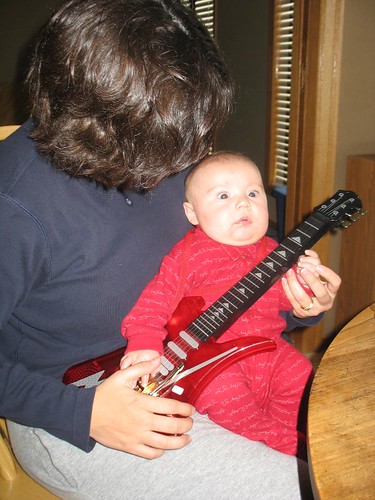
The Calgary Flames start their season tonight. Pace is wearing an orange off-red outfit in this picture but I'm sure his loyalties are clear.
My predictions for the final this year are Flames over Tampa Bay in a re-match of 2004 with the right team winning this time.
Pace is picking the Ducks repeating as Cup champs, this time over Boston, mostly because he likes both team logos (especially the bear that's on Boston's third jersey).
 )
)